

The Counter-Drone Cycle Ends Too Early
A quadcopter comes down outside a partner forward operating base. The counter-UAS system did its job. The immediate threat is gone. A soldier walks out past the wire, picks up the airframe, and carries it back inside.
Then what?
In most units, the answer is a shelf. The drone sits there. Eventually someone photographs it for a report. Finally it gets thrown away, or it gets crated up and shipped to a laboratory that will return findings in a few months — long after the information could have changed anyone's decisions.
That drone knew where it launched from. It knew who programmed it and how. It knew what it had already photographed. It carried components that someone bought, shipped, and soldered. All of that walked back through the gate and went into a corner.
Every step in the cycle points at one outcome
The established counter-UxS cycle runs Detect, Track, Identify, Decide, Defeat. Billions of dollars in sensors, effectors, and command-and-control exist to move a threat through those five steps as fast as possible.
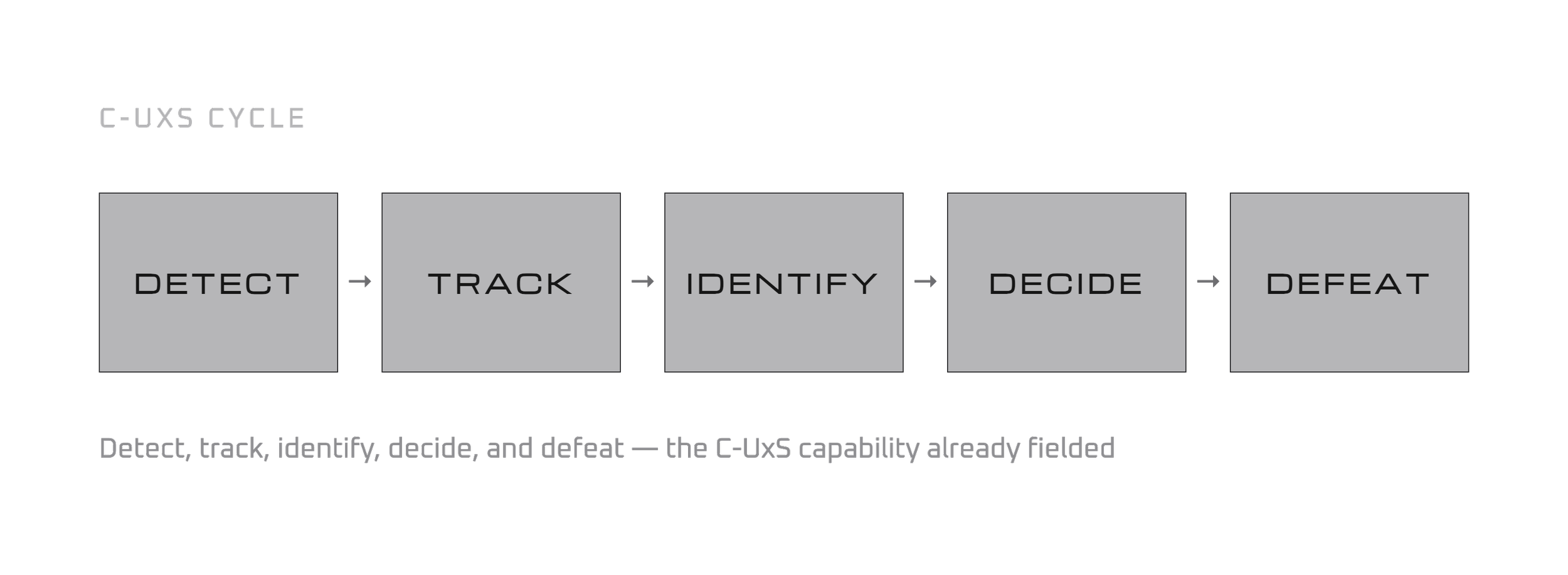
The cycle works. It also stops the moment the aircraft hits the ground.
Defeat solves one aircraft. It does nothing about the workshop that built it, the supplier who shipped the flight controller, the operator who flew it, or the 12 identical airframes waiting in a shipping container. Those launch tomorrow, and the unit meets them with exactly the same information it had yesterday.
Adversary drone programs iterate in weeks. A counter-drone posture that learns nothing from each engagement will always be one generation behind.
What a recovered system actually holds
A downed drone is a populated storage device attached to a bill of materials.
Flight controllers log flight paths. Ground control software leaves pre-programmed waypoints, launch points, and recovery points. Onboard media holds imagery and video from previous missions. Firmware versions, radio configurations, and software settings form an operator fingerprint that is often more distinctive than the airframe itself. Components carry manufacturer marks, model numbers, and chip markings that trace back to a supply chain.
Put together, this identifies the aircraft, the unit that flew it, and the network that built and supplied it.
None of that is exotic. The barrier has never been whether the data exists. The barrier is who is allowed to touch it and how long the answer takes.
Exploit, Analyze, Disseminate
The cycle needs three more steps after Defeat.
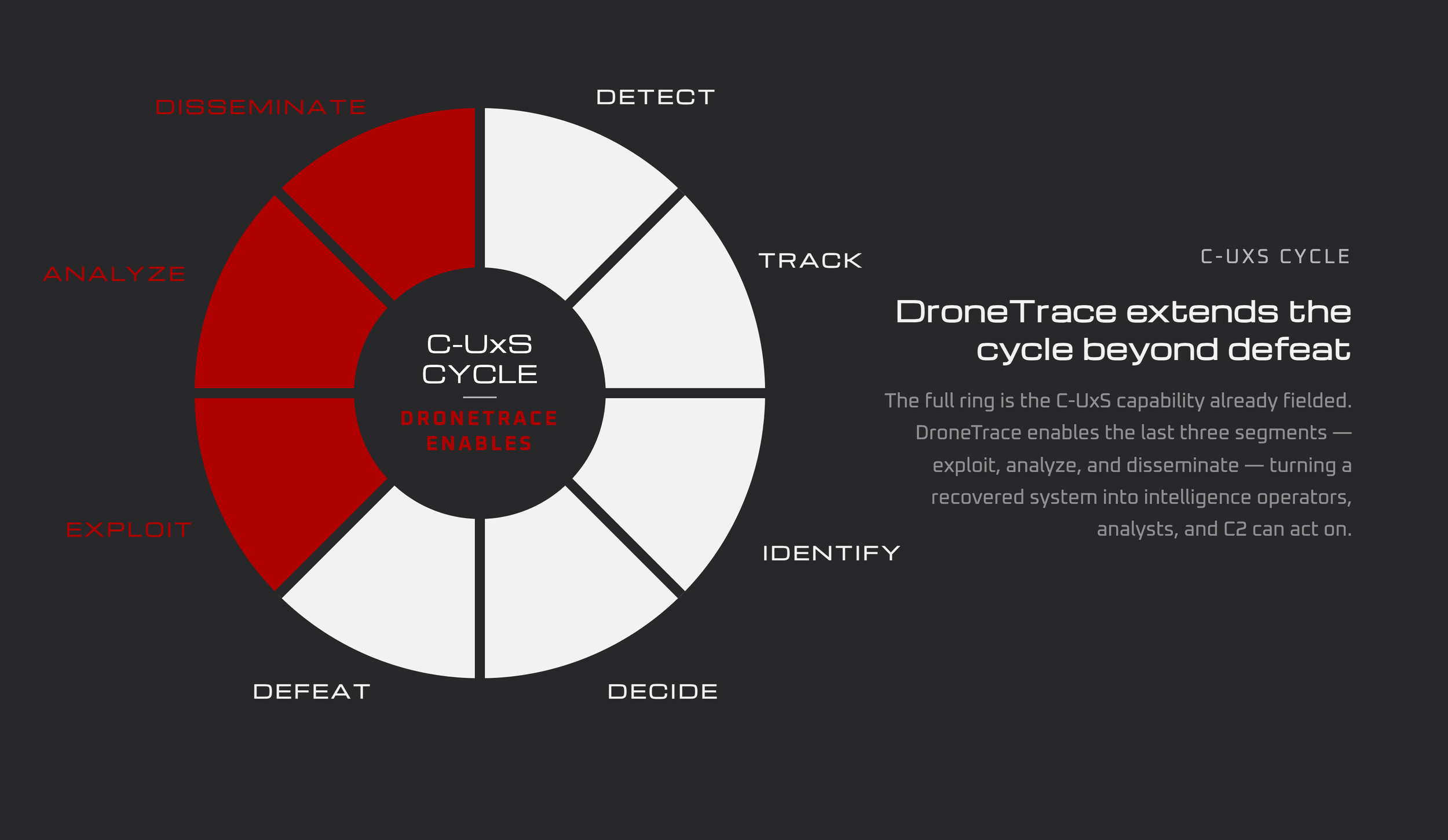
Exploit. Pull the data off the system at the point of recovery. This has to happen in the field, offline, in a connectivity-denied environment, performed by the person who picked up the drone. It has to be forensically sound (write blocking, hashing, and chain of custody) because the output may end up in an intelligence product or in a courtroom. And it has to take minutes.
Analyze. One recovered drone is an anecdote. Fifty recovered drones are a pattern. Correlation across time, geography, unit, component, firmware, flight route, and radio frequency turns individual recoveries into a threat picture. That is where a unit learns that three sites are seeing the same flight controller, or that a launch point keeps repeating, or that a supply chain shifted vendors last month.
Disseminate. Push the finding to the people who can act on it. Force protection changes. Targeting packages. Left-of-launch collection priorities. Requirements for the engineers building the next counter-UxS system. Releasable intelligence for partner forces working the same threat. A finding that stays in the analytic environment changed nothing; dissemination ends with someone doing something differently.
Run those three steps and the counter-drone fight stops being a series of disconnected engagements. It becomes a loop that compounds.
The scaling problem specialists can't solve
If exploitation requires a trained digital forensic examiner, it happens at the number of locations where you have examiners. That number is small, and it stays small. Partner forces will never have it. Forward sites will never have it. Every drone recovered somewhere without an examiner gets shipped, delayed, or lost.
The way out is to make the tool carry the rigor so the operator doesn't have to. When write blocking, hashing, and chain of custody are enforced by the device itself, exploitation can become an operator task without giving up the forensic soundness a courtroom demands. An EOD technician, a SOF operator, a partner soldier, and an intelligence analyst all need to reach basic proficiency in about 30 minutes and produce output an examiner would defend. That single design decision determines whether a program covers five sites or 500.
Aggregation makes the same argument from the other direction. Analysis gets better as coverage gets wider, and coverage only gets wider if the tactical end is easy. Hard tools produce thin data, and thin data produces weak patterns.
Where DroneTrace fits
DroneTrace is designed around this problem.
DroneTrace Edge handles exploitation at the point of recovery. It runs on a rugged tablet, works completely offline, and acquires data from commercial platforms, custom FPV airframes, open autopilot ecosystems, and larger Group 2 and 3 systems (the heavier, longer-range aircraft above the small quadcopter class). Outputs include flight paths, launch and recovery locations, onboard imagery with AI-assisted triage, configuration fingerprints, and component-level detail.
DroneTrace Cloud handles analysis. It aggregates exploitation from every device in a theater, correlates across recoveries, manages cases and evidence, and searches component supply chains by keyword or reverse image match.
UTEC (the UAS Technical Exploitation Course) handles the human side. It qualifies non-technical personnel to run the workflow and gives a unit standardized TTPs it keeps.
Together they support a hub-and-spoke model. Spoke sites handle exploitation, and a central hub handles analysis. Findings flow back out through TAK, Lattice, and standard reporting to the operators and partners who need them.
The point
Detect, Track, Identify, Decide, Defeat solves the aircraft in the air.
Exploit, Analyze, Disseminate solves the program behind it.
A counter-drone architecture without an exploitation layer leaves its highest-value intelligence sitting exactly where it landed. Every drone your force brings down is a free collection opportunity you have already paid for. Recover it, exploit it, and let the next engagement start from everything the last one taught you.